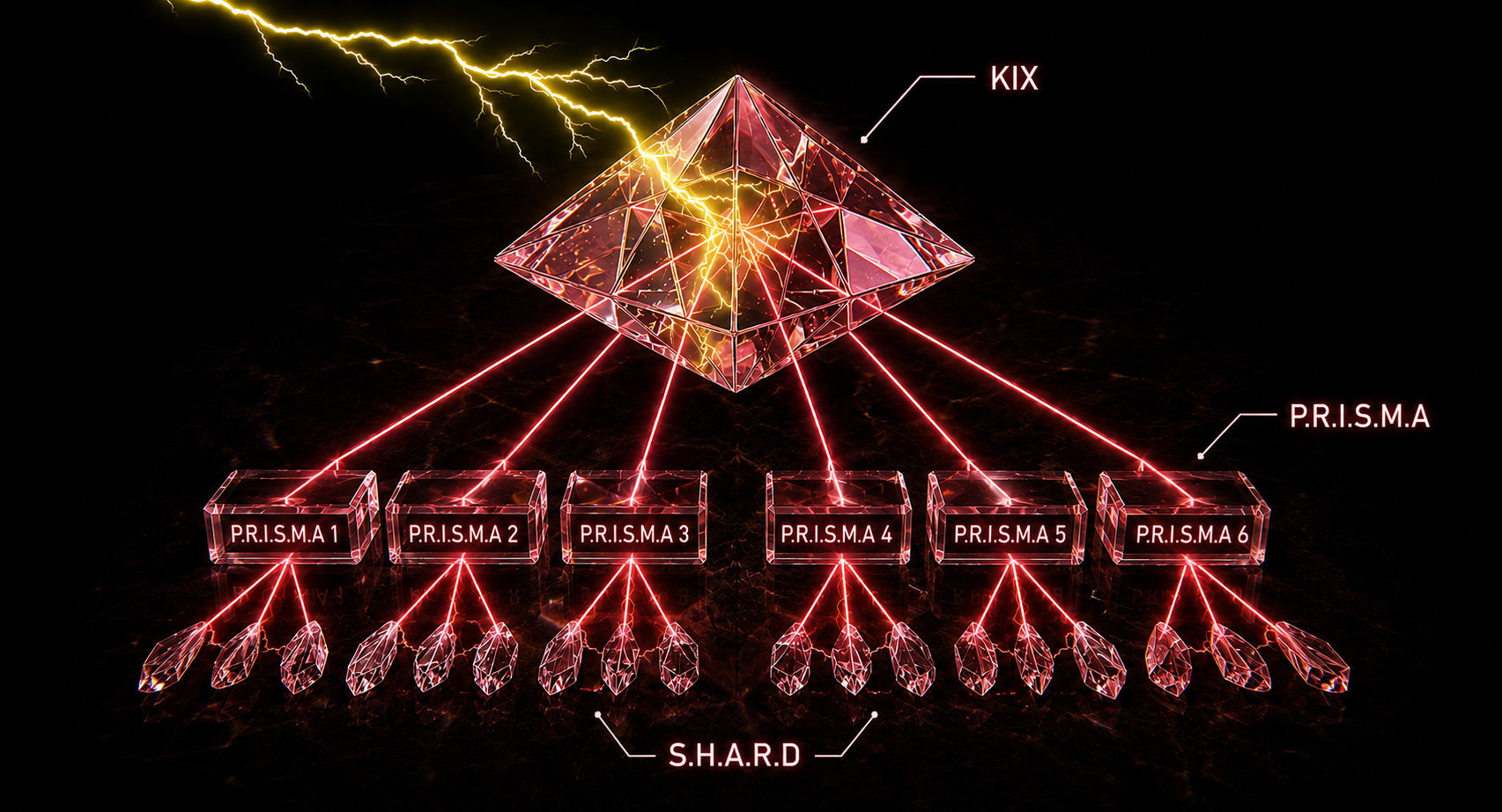
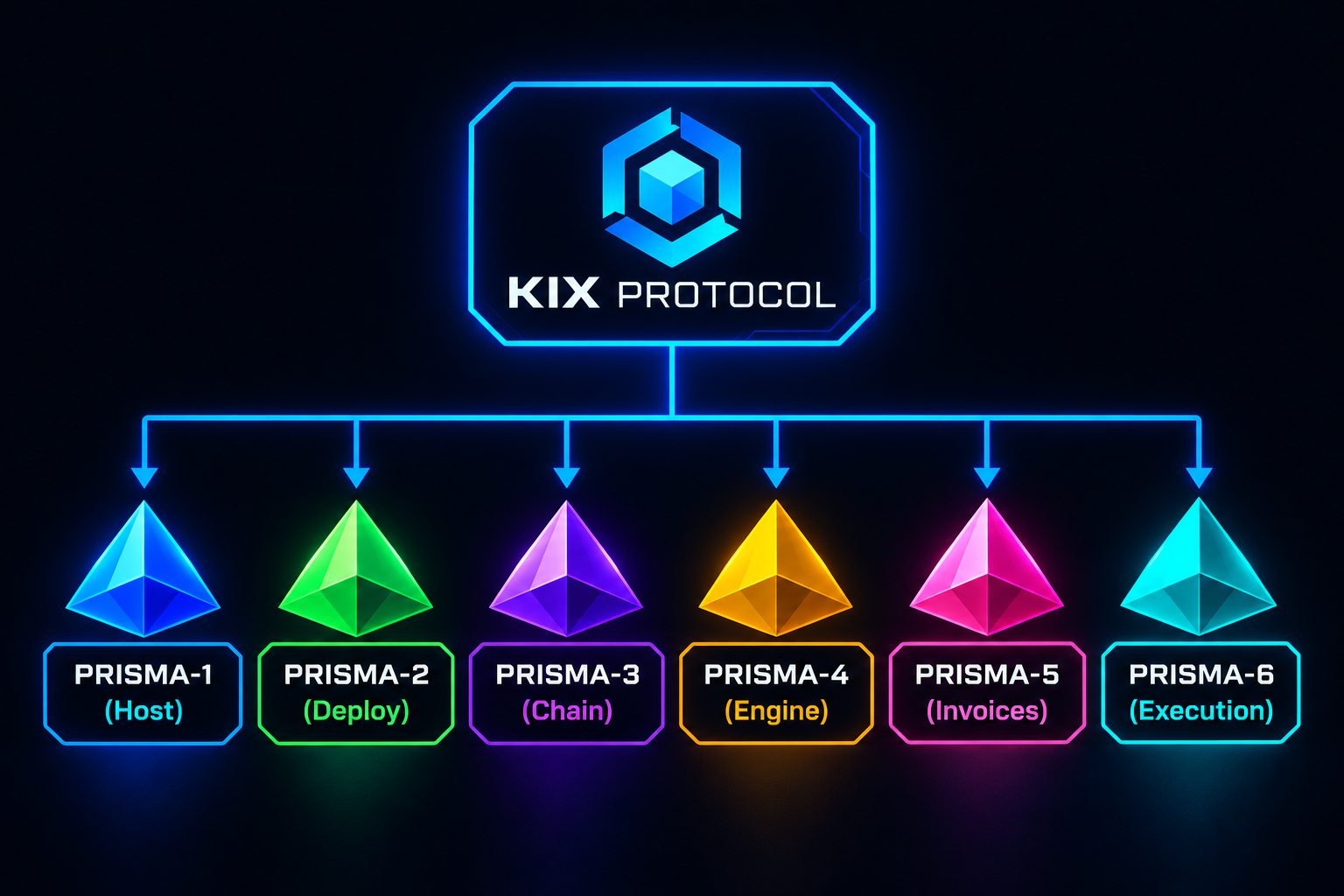
PRISMA-1 establishes the physical and
operational foundations of the KIX protocol, defining the
hardware and operating system environments capable of
supporting a P.R.I.S.M.A. implementation. The model
supports Linux, Android, and Windows environments while
maintaining a multi-platform architecture primarily based
on 64-bit environments, with x86_64 and ARM64 compatibility
and planned RISC-V support.
Architectures and Sizing
-
ARM64 / SBCs:
NanoPi, Orange Pi, and Raspberry Pi for
constrained or embedded profiles.
-
x86_64:
local servers, dedicated PCs, and cloud infrastructure.
-
64-bit:
reference architecture for component stability
and interoperability within the framework.
S.H.A.R.D. Examples
Micro-Embedded
Hardware:
Sunmi V2 or ultra-compact SBC.
OS:
Android / Termux or lightweight Linux.
Resources:
1–2 GB RAM, 8 GB eMMC/SD.
Use:
Portable POS and lightweight settlement client.
Edge / Shop Floor
Hardware:
NanoPi R4S, Orange Pi 5, or Raspberry Pi 4.
OS:
Armbian / Debian Minimal.
Resources:
2–4 GB RAM.
Use:
local counter server.
Standalone Desktop
Hardware:
x86 PC or Mini-PC.
OS:
Ubuntu Server / Debian or Windows + WSL2.
Resources:
4–8 GB RAM, 128 GB SSD/NVMe.
Use:
local node and POS database.
Cloud / Enterprise Node
Hardware:
VM or dedicated server.
OS:
Enterprise Linux.
Resources:
8 GB+ RAM and 256 GB+ NVMe.
Use:
store centralization and clustering.
PRISMA-2 defines containerization,
process isolation, and network exposure strategies.
It standardizes how KIX microservices are packaged,
orchestrated, and made available through Docker, Podman,
bare-metal execution, and different connectivity
mechanisms.
Exposure Strategies
-
Tor:
.onion hidden services for privacy
and NAT/CGNAT traversal.
-
Cloudflare / Tailscale:
tunnels and private networks for controlled exposure.
-
Clearnet:
public IPv4/IPv6 with reverse proxy and TLS.
-
LoRa / Mesh:
resilient communication in environments without
internet access.
S.H.A.R.D. Examples
Sovereign Darknet
Runtime:
Docker / Podman.
Network:
Tor .onion v3.
Use:
sovereignty and IP privacy.
Secure Tunnel
Runtime:
Docker Compose.
Network:
Cloudflare Tunnel / Tailscale.
Use:
POS terminals and public webhooks.
Public Clearnet
Runtime:
systemd or Docker host-network.
Network:
IPv4/IPv6 + Nginx/Caddy + TLS.
Use:
gateways and edge servers.
Mesh & Offline-Resilient
Runtime:
lightweight binaries.
Network:
LoRa, Wi-Fi/Bluetooth Mesh, or serial.
Use:
local communication without internet access.
PRISMA-3 specifies how the application
connects to, validates, and synchronizes Bitcoin blockchain
state. The layer abstracts the complexity of On-Chain
consensus to provide reliable information to Lightning
engines and backend services.
Data Sources
-
Bitcoin Core / bitcoind:
full validation through a self-hosted node.
-
Esplora / Fulcrum:
high-performance indexing.
-
Neutrino:
validation through BIP 157/158 compact filters.
-
RPC / ZMQ / WebSockets / REST:
communication with local or remote sources.
S.H.A.R.D. Examples
Sovereign Full
Engine:
bitcoind Full/Pruned + ZMQ.
Reliability:
complete local validation.
Compact Light
Engine:
Neutrino.
Reliability:
minimized trust through compact filters.
Indexed Gate
Engine:
Esplora / Electrum.
Use:
high-speed indexed queries.
Remote RPC / Provider Relay
Engine:
WebSockets / ZMQ / middleware.
Reliability:
delegated to the remote provider.
PRISMA-4 establishes an abstraction layer
for managing and switching between Lightning engines.
The application and POS terminals remain agnostic to the
payment backend, allowing the use of local engines,
self-hosted servers, or remote providers.
Connectivity Architecture
-
Self-Hosted:
LND and Core Lightning with direct control over
keys and liquidity.
-
Modular:
LNbits and Alby Hub for multi-store management.
-
Autonomous:
Phoenixd for automated operations.
-
Remote:
NWC for connecting to external wallets and services.
-
LDK:
implementation through SDKs and managed providers.
S.H.A.R.D. Examples
Native Enterprise
Engine:
LND / Core Lightning.
Topology:
Self-Hosted.
Use:
high-volume sovereign nodes.
Modular Engine
Engine:
LNbits / Alby Hub / Alby Vault.
Use:
balance isolation and multi-store management.
Autonomous Server
Engine:
Phoenixd.
Topology:
local or edge server.
Use:
automated liquidity management.
Delegated Remote
Engine:
NWC.
Topology:
external provider.
Use:
terminal without local Lightning infrastructure.
Embedded SDK
Engine:
LDK / managed providers.
Use:
delegating network complexity while maintaining
key control.
PRISMA-5 specifies the dynamic generation,
interpretation, and conversion of payment requests,
ensuring POS interoperability across multiple Lightning
and On-Chain formats, including fallback strategies for
network degradation scenarios.
Formats and Fallback
-
BOLT 11:
single-use invoices with broad compatibility.
-
BOLT 12:
reusable Offers and dynamic payment requests.
-
LNURL-Pay / Address:
dynamic generation through HTTP/HTTPS.
-
BIP 21:
combination of On-Chain and Lightning addresses.
-
eCash / Credit:
contingency mechanisms for temporary
infrastructure unavailability.
S.H.A.R.D. Examples
Native Standard
Encoder:
BOLT 11 / BOLT 12.
Fallback:
single-use invoice with short expiration.
Unified Universal
Encoder:
BIP 21 + LNURL.
Fallback:
On-Chain or LNURL when Lightning fails.
Contingency & Tokenized
Encoder:
eCash / vouchers / local credit.
Fallback:
tokenized payments during connectivity failures.
PRISMA-6 defines how computational load
is distributed between the checkout terminal and backend
infrastructure. The architecture allows the same payment
logic to run on full servers, microcontrollers, and
intermediate Android terminals.
Execution Profiles
-
PRISMA-6-HEAVY:
Django, FastAPI, Docker, databases, and full
Lightning engines.
-
PRISMA-6-LIGHT:
ESP32 and microcontrollers delegating intelligence
to the HEAVY server.
-
PRISMA-6-HYBRID:
Android/Termux and portable POS terminals running
intermediate applications.
S.H.A.R.D. Examples
Heavy Server
Profile:
PRISMA-6-HEAVY.
Host:
x86_64 / ARM64 Linux.
Use:
checkout, webhooks, database, and
Lightning management.
Micro-Terminal
Profile:
PRISMA-6-LIGHT.
Host:
ESP32 / STM32 + TFT.
Use:
visual interface, QR Code, and confirmation.
Mobile POS
Profile:
PRISMA-6-HYBRID.
Host:
Android / Termux.
Use:
waiters, deliveries, remote APIs, and printing.